Learn the Arabic and Persian Alphabets, their pronunciation and their differences.
As mentioned in part one , the Persian and Arabic languages share the same ahabets with four extra letters in the Persian language. Those letters and their equivalent letters in English are explained below. However, before learning the letters, one should keep in mind the following:
- Arabic (and Persian) is written horizontally from right to left.
- Although the two languages share the alphabet some letters are pronounced slighlty differently in Persian than in Arabic.
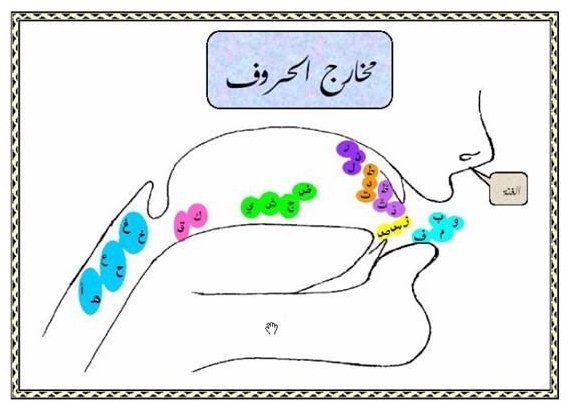
- Some letters are labeled as throat letters; the sound is produced from end of the throat or mid throat, as illustrated in the following link: picture These letters do not have an equivalent in English, and most are not pronounced from throat in Persian.
These are the letters and their equivalents in the English alphabet:
Alif = أ = As in A for Apple
Baa =ب = As in B for Ball
Ta = ت = As in T for Table
Tha = ث = As in Th for Thank you; (however, this is pronounced as S for sea, in Persian)
Jeem = ج = As in J for James
Haa = ح = This Arabic letter has no equivalent in English; it is a throat letter and the closest pronouciation is as H for Hat, and that is how it is pronounced in Persian
Kha = خ = Another throat letter, which is pronounced alike in both Arabic and Persian, it is usually expressed as (kh).
Daal = د = As in D for Door
Thzaal = ذ -As in Th for These
Raa = ر= As in R in Red
Seen = س= As in S in Sea
Sheen = ش= َِAs in Sh in shine
SSaad = ص= As in S ( stressed S) a whistle sound, however, it is pronounced as S in Sea in Persian
Dhad = ض= This is another letter which has no equivalent in English, but the nearest letter sound is Dh; in Persian it is pronounced as Z in Zoo
TTa = ط= A stressed T; in Persian it is simply pronounced as T as in Table
Thza = ظ= There is no such equivalent in English; it can be pronounced with a combination between th and Z, in Persian it is simply another letter pronounced as Z
Ain = ع= A throat letter; in Persian it is pronounced as A for Apple
Ghain = غ = A throat letter which is pronounced alike in both Arabic and Persian and has no English equivalent. (It is pronounced as is French for R)
Faa = ف= As F in Food
Qaf = ق= Does not have an equivalent in English, and In Persian it is mostly pronounced as K
Kaf = ك= As K in Kite
Lam = ل= As L In Lion
Meem = م= As M in Milk
Noon = ن= As N inNadia
Haa = هـ= as H in Hat
Waw = و= As W in Water
ya = ي= As Y in Yougurt
Hamza = ء = As A in Apple.
The Four letters which are in the Persian alphabets but not in the Arabic alphabet are:
Peh = پ = P in People
Cheh = چ= Ch in Chart
ja = ژ= Does not have an equivalent in English; nearest letter is J
Gaf = گ= as G in Game
Notice that there are 18 letter shapes out of 32 letters in Persian and Arabic; they are differentiated by adding one or two or three dots to the letter according to their phonetic character.
This post is part of the series: Arabic Language
Learning and knowing about Arabic Language