Spanish idioms add cultural luster to learning the language. This article introduces fourteen Spanish family- and marriage-related idioms that the Spanish teacher can incorporate into weekly lesson plans for literal translation, discussion, and cultural relevance.
Teaching Spanish Idioms
The Hispanic culture has a number of instructive and humorous idioms (sayings). Many sayings that are related to marriage and family have counterparts in English while some are uniquely Hispanic. Spanish teachers can incorporate many of these sayings as a tool for both language learning and as a way to bridge cultural understanding through language analysis.
Suggested Class Activity
Incorporate one Spanish idiom into each weekly lesson plan. Ask the class to consider the following questions when addressing each Spanish saying:
- How does the saying translate literally from Spanish to English?
- In the context of our own culture, what does the saying really mean?
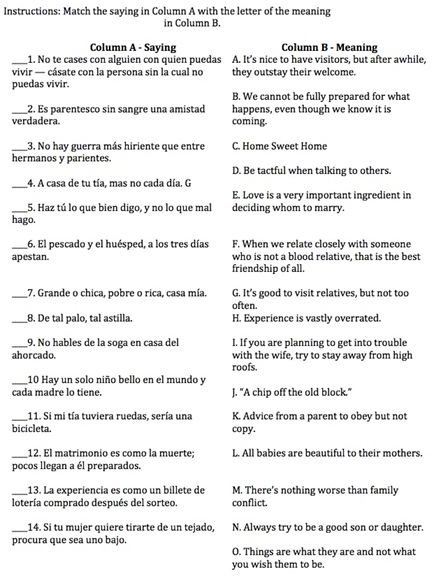
As another incentive to learning the true meanings of the Spanish sayings, tell students to be prepared for a matching quiz that incorporates each weekly saying. (Click on the images at the end of this article to see the sample quiz and answer key.)
Week 1
Grande o chica, pobre o rica, casa mía.
Literal translation: Big or small, grand or modest, it’s my house.
In context: “Home sweet home.”
Week 2
No te cases con alguien con quien puedas vivir—cásate con la persona sin la cual no puedas vivir.
Literal Translation: Don’t marry someone you can live with—marry the person you can’t live without.
In context: Love is the most important ingredient in choosing the person whom you are going to marry.
Week 3
El matrimonio es como la muerte; pocos llegan a él preparados.
Literal meaning: Marriage is like death; few arrive there prepared.
In context: We cannot be fully prepared for marriage.
Week 4
Hay un solo niño bello en el mundo y cada madre lo tiene.
Literal translation: There’s only one beautiful little baby in the world, and each mother has it.
In context: All babies are beautiful to their mothers.
Week 5
De tal palo, tal astilla.
Literal translation: From such a stick, such a splinter.
In context: “A chip off the old block.”
Week 6
A casa de tu tía, mas no cada día.
Literal translation: To the house of your aunt, but not every day.
In context: It’s good to visit relatives, but not too often.
Week 7
El pescado y el huésped, a los tres días apestan.
Literal Translation: Guests, like fish, stink after three days
In context: It’s nice to have visitors, but after three days they outstay their welcome.
Week 8
No hables de la soga en casa del ahorcado.
Literal translation: Don’t talk about the noose in the house of the hanged man.
In context: Be tactful when visiting other people’s homes
Week 9
Es parentesco sin sangre una amistad verdadera.
Literal translation: Kinship without a blood relationship is true friendship.
In context: When we relate closely with someone who is not a blood relative, that is the best friendship of all.
Week 10
No hay guerra más hiriente que entre hermanos y parientes.
Literal translation: There is no war more hurtful than one within the family.
In context: There is no worse conflict than one between siblings and relatives.
Week 11
Si tu mujer quiere tirarte de un tejado, procura que sea uno bajo.
Literal translation: If your wife wants to throw you off a roof, make sure it’s a low roof.
In context: If you’re going to get in trouble with your wife, only misbehave a little bit.
Week 12
Haz tú lo que bien digo, y no lo que mal hago.
Literal translation: Do as I say, not as I do.
In context: What parent hasn’t said (or at least thought about) this when telling a child how to behave?
Week 13
La experiencia es como un billete de lotería comprado después del sorteo. No creo en ella.
Literal translation: Experience is like a lottery ticket bought after a drawing. I don’t believe in it. (Gabriela Mistral, Chilean poet)
In context: What child hasn’t said (or at least thought about) this when listening to a parent?
Week 14
Si mi tía tuviera ruedas, sería una bicicleta.
Literal Translation: If my aunt had wheels, she would be a bicycle.
In context: “If wishes were horses, beggars would ride.” (Things are what they are, not what we wish them to be.)
Spanish Family Idioms Matching Quiz