The Spanish past subjunctive is used in most of the same situations as the present subjunctive, except that it always points to a past situation. It is formed in a consistent way by removing the third person plural preterite -ron and inserting a special set of endings.
Past Tense
Also referred to as the imperfect subjunctive, the past subjunctive is used in the same situations as the present subjunctive, but the point
of reference is always in the past. When the verb in the main clause is in the past, the verb in the subordinate clause is in the past subjunctive. For example, to say, “I was afraid that we were going to arrive late,” you would need the past subjunctive: Temía que llegáramos tarde.
Dropping the Ending…
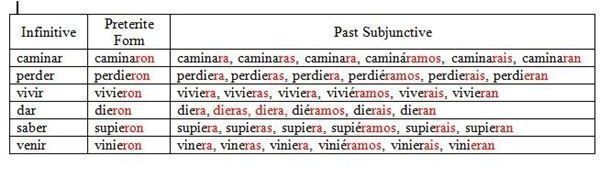
Recall that the present subjunctive is formed by dropping the ending from the first person singular and adding special endings. See the article in this series on the present subjunctive. The past subjunctive is formed by dropping the -ron ending from the ustedes/elos/ellas form of the preterite and adding the past subjunctive endings -ra, ras, -ra, -ramos, rais, -ran. (The nosotros/as form of the past subjunctive always has a written accent.)
The chart on the left has a few examples.
Below is another example sentence using the above endings:
Le pedí a Juan que viniera a ayudarnos. I asked Juan to come help us.
Uses of the Past Subjunctive
♦ Use the past subjunctive in the same situations as we learned for the present subjunctive – statements of doubt, wistfulness, with phrases such as es importante/bueno/lástima que, etc. As mentioned above, though, our tense shifts when the main clauses begins with a past tense (preterite or imperfect) verb. Let’s compare the present subjunctive with the past subjunctive with comparative examples:
Present: Mariela sugiere que hagamos una excursion. Mariela suggests we go on an excursion.
Past: Mariela sugirió que hiciéramos una excursion. Mariela suggested that we go on an excursion.
Present: Dudan que Eduardo venga. They doubt that Eduardo is coming.
Past: Dudaban que Eduardo viniera. They doubted that Edward would come.
Present: Temo que llueva. I’m afraid it’s going to rain.
Past: Temía que lloviera. I was afraid that it would rain.
♦ Use the past subjunctive with querer to make polite requests:
Quisiera papel reciclado, por favor. I would like recycled paper, please.
¿Quisieras algo de beber? Would you like something to drink?
♦ Use the past subjunctive following the expression como si (as if):
Me saludó como si no me conociera. She greeted me as if she didn’t know me.
Hablaba del accidente como si no le importara**.** He spoke of the accident as if it were not important to him.
Emilio siempre se viste como si fuera invierno. Emilio always dresses as if it were winter.
More Like This on Bright Hub Education
Learning Spanish: Doubling Up With Spanish Compound Verbs
Learning the Spanish Subjunctive in Adjective Clauses
Subjunctive Mood in Adverbial Clauses
This post is part of the series: Learning Spanish: The Subjunctive Mood
Spanish verbs come in two moods: the indicative (stating the real) and the subjunctive (stating the hypothetical or wishes). This series is all about the subjunctive, which Spanish uses much more extensively than English.