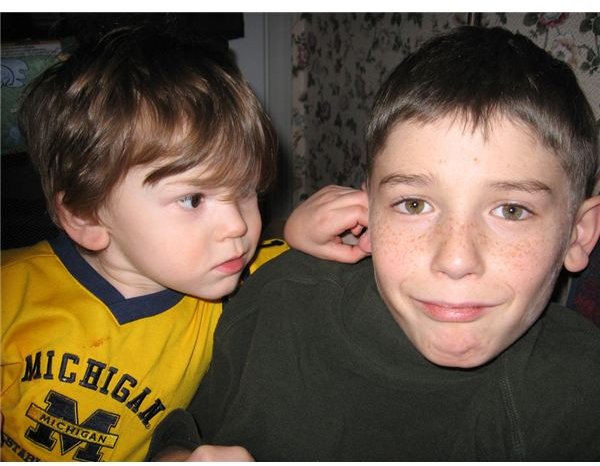
Hear Ye! Hear Ye! Young children can learn to appreciate and protect their sense of hearing, which helps them discover the environment around them. Here’s how to make it fun and informative.
The sense of hearing enriches our lives and protects us, too. Think of how you feel when you hear your favorite song or listen to a bird chirping in the spring. Then imagine what would happen if you were crossing a street and didn’t hear a car coming. This lesson will provide you with activities and information to help your students understand and appreciate the sense of hearing.
Learning Objectives:
1. Students will discover that we use our senses to learn about the world around us.
2. Students will learn that we gather sound in our ears and our brain makes sense of what we are hearing.
3. Students will learn how to protect our ears and how our ears can protect us.
Materials:
Book: Hearing by Rebecca Rissman or a similar choice.
scarf (blindfold)
Vocabulary:
Brain: the “computer” part of your body which helps you think, move, feel and remember
Deaf: unable to hear
Hearing Aid: a device that helps people hear
Protect: to keep something safe
Senses: abilities of the body that helps you hear, see, smell, taste and feel
Procedure:
Begin with the book Hearing by Rebecca Rissman. There are many books on this subject so you can use a book that is available and one that fits your objectives. Show your students the book and tell them that it is a nonfiction book, which means that the information is real. Focus on these basic facts:
- Your ears collect the sounds and send messages to the brain and your brain tells you what you are hearing.
- You can hear sounds that are loud or soft, close or far away, high or low.
- People that cannot hear are deaf. Sign language and hearing aids can help them.
- Never put objects in your ear. It can damage your ear.
- We hear different things in different places and in different seasons. We may hear different sounds at school than at home. We may hear different sounds in summer than in winter.
- Our sense of hearing can protect us from danger. For example you may hear a car horn honking to warn you when you are riding your bike. Or you may hear the fire alarm if there is a fire in the building.
- Because we have two ears it is easier to tell where a sound is coming from.
Fun Facts:
- Dogs have 17 muscles they use to move their ears around to hear sounds better.
- When your brain gets messages from your eyes and ears that don’t match, your brain usually believes your eyes. Tell someone to touch his or her chin while you touch your ear instead. See which one they do.
Activity:
Instruct the children to sit in a large circle on the floor. Place a chair in the center of the circle. Choose a student to sit in the chair. That person is “it”. Tie a blindfold (the scarf) to cover the student’s eyes. Make sure you ask the child’s permission! Some students will not feel comfortable using the blindfold.
Then point to a student in the circle. That student, “the speaker”, then says hello to the child in the chair. The speaker can use a disguised voice or a normal voice. The student in the chair has to guess who is speaking. Allow only 2 or 3 guesses. Give everyone a chance to be “it”. Then discuss how it felt to hear things without seeing them.
Assessment:
Use the provided worksheet or a plain sheet of paper. Choose a topic such as: summer, winter, spring, fall, school, home, playground, mall, etc.
Then fill in the blank “I hear these things in ________________.” Students must write the words or draw a picture of things they hear appropriate to the topic.
Resources:
Rissman, Rebecca. Hearing. Heinemann Library, 2010.
Collins, Andrew. See, Hear, Smell, Taste and Touch: Using Your Five Senses. National Geographic, 2006.
Romanek, Trudee. Wow! The Most Interesting Book You’ll Ever Read About the Five Senses. Kids Can Press, Ltd., 2004.
Prochovnic, Dawn. Four Seasons! Five Senses! ABDO Group, 2012.
References
- Photo by Qfamily under CC BY 2.0 via Flickr
This post is part of the series: Exploring Our Five Senses
This series of Kindergarten lesson plans focuses on exploring the five senses. Teach your students to interact with their world through seeing, hearing, smelling, tasting and touching!


