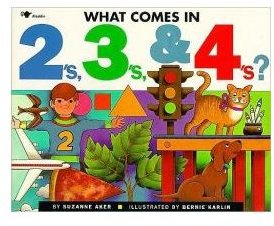
Here is a two-day lesson plan to use with young students to help develop their number sense. You will find related books, homework, assessment suggestions and fun activities.
Even young children can begin to understand that math is not just an isolated subject in school. When looking for patterns, shapes and numbers we see that math is all around us. Reinforce this idea by doing a lesson on the relationship between numbers and quantities as students explore sets of objects in the world around them.
Lesson Plan for Day One
Objective:
Students will develop number sense relationships between numbers and quantities.
**
Materials:
- Book: What Comes in 2’s, 3’s & 4’s?
- Old magazines
- Copies of the 2’s, 3’s and 4’s paper (an alternative would be to divide a paper into 3 sections/columns)
- Scissors
- Glue sticks
Procedure:
Before reading the book, What Comes in 2’s, 3’s & 4’s? brainstorm with your students to create a list of “sets” or groups of like objects. For example, even in the classroom, you may have a set of blocks, a set of science books or a checkers set.
Hold the book up and tell the students that they will be listening to a nonfiction book, which means that it has real information. The book contains examples of sets. When you begin the section “What Comes in 2’s?” write the number 2 on the board and ask the students to hold up two fingers. Then continue with the book. At the end of the section take time for the students to suggest other sets of two that are in the room. Perhaps you have two playground balls, two jump ropes, two computers or two light switches.
Continue with this same format to complete the section on 3’s and 4’s.
Activity:
Provide old magazines, scissors and glue sticks for each student. You may choose to have pairs of students share a magazine. Instruct the students to find one or two examples of each set (2’s, 3’s or 4’s) of objects in the magazine. The students should then cut the example out and glue it in the appropriate section on their papers.
Download the paper to go with this activity.
Homework:
Encourage the students to be more observant of their surroundings. With the help of a parent or caregiver, the student should write down examples of sets of two, three and four found in their homes.
Lesson Plan for Day Two
Objective:
Recognizing the number of objects in sets of 2, 3 or 4 without having to count.

Materials:
- Book: Anno’s Counting Book
- List of things with 2, 3 or 4 in a set. (See below for suggestions.)
- Index cards
- Construction paper- all the same color, one per student
- Music (Or you can sing!)
- Drawings or pictures that have sets of 2, 3, and 4.
Procedure:
Begin the lesson by sharing Anno’s Counting Book. This is a book without words but with artwork that can be interpreted on many levels. Encourage participation as students view the beautiful illustrations and count the items in each set.
Activity:
It’s time to get the students up and moving! Use the construction paper and write the numerals 2, 3 or 4 on each paper. Use a marker and make it large enough for everyone to see. Then spread the numbers out in a circle. Instruct the students to stand on the numbers. One student per number. Tell the students that they are to face in one direction and move around the circle stepping on the numbers while the music plays. When the music stops the children should stop and stand on the closest number to them.
Next read one of the items from the following list or make up your own. The students who are standing on the correct number should sit in the middle of the circle for only one turn. Then go on to the next item. Continue playing as time allows.
“How Many” List:
eyes on a fox, number of lights on a traffic light, legs on a chair, sides on a triangle, moons do we have, tails on a squirrel , ears does Mom have, wheels on a wagon, mittens in a pair, shoes on your feet, doors in our classroom, number of legs on a dog, wheels on a tricycle, horns on a car, pieces of bread in a sandwich, how many meals in a day, arms on your teacher, wings on an airplane, side on a square.
Assessment:
Use the index cards. Write the number 2 on one card, 3 on one card and 4 on the last card. Place the three cards in front of the student. You may choose to make more than one set of cards and assess a group of students. Next show a picture or say one of the choices from the “How Many” list and instruct the student to hold up the right number. Continue until you feel the assessment is accurate.
References
- Anno, Mitsumasa. Anno’s Counting Book. Harper Festival, 1992.
- Aker, Suzanne. What Comes in 2’s, 3’s, & 4’s? Simon and Schuster, 1990.


