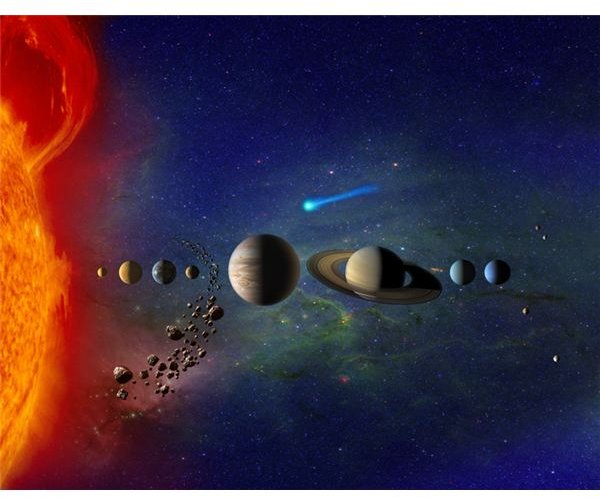
This Planet Poster can be assigned at the end of a unit on the solar system. Middle schoolers enjoy choosing their own planet and using their creativity to produce an interesting and informative astronomy poster displaying what they learned about their planet.
Instructions for the Planet Poster
These instructions are for an eighth-grade physical science class, but they can be adjusted according to the grade and the curriculum being
followed.
Introduction: Make a poster about a planet of your choice. The poster should be on a sheet of poster board, and should include a drawing or a picture of your planet. Make sure your poster contains all of the required information listed below for full credit.
Choose one planet from the following list: Mercury, Venus, Mars, Jupiter, Saturn, Uranus, Neptune
On your Planet Poster, include the following information about your planet:
- Name of your planet
- Mythological origin of your planet’s name
- Order of this planet from the sun (first, second, etc.)
- Average distance from the sun in miles, kilometers, and astronomical units
- Period of rotation (length of day)
- Period of revolution (length of year)
- Average density, g/cm3. Compare the average density of your planet with Earth’s average density. What percent of Earth’s density does your planet have?
- Temperature range, high and low (Fahrenheit and Celsius)
- Diameter in miles and kilometers. Compare the diameter of your planet with that of Earth. What percent larger or smaller is your planet than Earth?
- Compare the gravity of your planet with Earth’s gravity. What percent of Earth’s gravity does your planet have? If an object weighed 100 pounds on Earth, how much would it weigh on your planet?
- List the most common elements present and their physical state (solid, liquid or gas)
- Describe the atmosphere (if any) on your planet. List the gases present and their percentages.
- How many moons does your planet have? Describe any unique features found on your planet’s moons. What are the names of your planet’s moons? (If your planet has more than five moons, just name five.)
- What probes have been sent or are planned to be sent to your planet? Include names of the missions, when they were sent or are planned to be sent. What information have they found out about your planet?
- What does your planet look like? Describe its surface features, such as volcanoes, craters or canyons. Does your planet have rings? Describe the rings.
- Based on what you have learned, do you think life could exist on your planet? Think about what conditions a living organism would have to adapt to in order to survive on your planet when answering your question. Remember, life doesn’t necessarily mean life as we know it on Earth!
Information to help with this middle school astronomy project can be found below. Although this is considered a middle school project, you could easily adapt it to high school.
Nasa.gov - Solar System Exploration
Nasa.gov - Welcome to the Planets