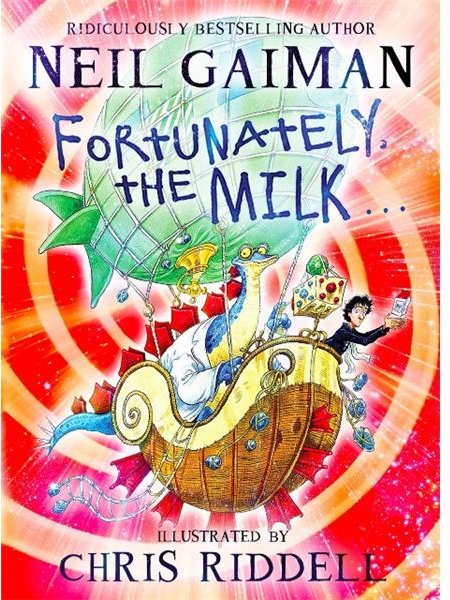
With these math and science activities, students will learn to create a flying “ship” and plot points on a graph, with cues taken from the novel, “Fortunately, the Milk.”
Part C. Engineering Lesson: Design a Balloon “Ship”
Materials
The novel, _Fortunately, The Milk_ by Neil Gaiman
- *Helium filled balloon
- Styrofoam or paper cup
- Dental floss
(*Available at most dollar- or party stores at minimal cost to the student)
To introduce this activity, revisit the novel to view the illustrations of Skottie Young’s balloon “ship.” Ask the students to brainstorm objects that could be lifted if tied to a balloon filled with helium. Have various objects on hand students can use to give them an idea of what they can use. Stress the importance that these objects must be light enough to float when attached to a helium-filled balloon.
For this task, students may work independently, in pairs, or in groups. The object is to get their “ships” to float when attached to the balloons. Perhaps demonstrating an object tied to a balloon would give the students an idea of how light the objects must be.
Requirements:
“Ship” must be able to float using various methods when tied to the balloons:
- Make a net —using a pin, poke evenly space holes around the perimeter of your “ship.” Cut even lengths of dental floss. Tie one end together in a knot. Loop the other ends through the holes on the “ship.” Place on balloon within the net.
- For multiple balloons, tie dental floss to the end of the balloons and loop through evenly spaced holes on the “ship.”
- Create a hyphenated adjective to name your ship and give author Neil Gaiman credit. Both must be visible somewhere on the “ship.”
Allow the students one week to complete their projects, and then reserve the gym or other place with a high ceiling to launch the “ships.” (Note: The purpose of performing the experiment indoors is not to fill the skies with possible litter!)
Part D. Math Lesson: Coordinate Picture Graphing
It would probably be best for students to know how to plot points on a graph. There are plenty of examples on the internet with which to practice individually or complete as a class using a graph template on a SMART Board by plotting the points on the attached worksheet.
For their assignment, the best approach is to have the students draw the picture first and then plot the points to create a four-quadrant picture. Students need only have the plot points to share with the class. This lesson is for pairs or groups.
Materials
- Graph paper
- SMART Board
- Pencils
- Picture graph examples
Requirements:
- One copy of completed picture graph with names or date.
- One copy of the plot points with names and date.
- Students can have multiple copies for the class to complete individually or present using the SMART Board.
This post is part of the series: Fortunately, the Milk by Neil Gaiman STEM Activites
Lessons for STEM (Science, Technology, Engineering, and Math) activities from the novel “Fortunately, the Milk” by Neil Gaiman. The Science and Math activities can be completed concurrently with the reading; all other activities are post-reading.