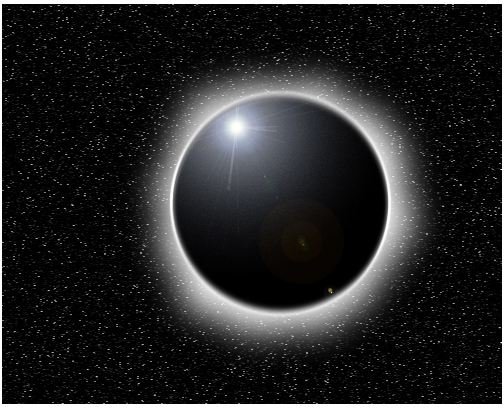
Solar and lunar eclipses are wonderful things to experience and observe. However, when learning about solar and lunar eclipses, there is not always an eclipse happening to observe! This article suggests a few activities to help students learn about solar and lunar eclipses.
Create Your Own Solar Eclipse
A solar eclipse, where the moon blocks out the light of the sun, is easy to simulate within the classroom. A grape-sized ball of clay, 2 sharp pencils, and a 3-inch Styrofoam ball is all that is needed for this activity. It would be ideal for more than one set of these items to be available so that every student is able to get an opportunity to “view” an eclipse.
The ball of clay, which represents the moon, and the Styrofoam ball, which represents the sun, should each be stuck on top of a pencil. The sun should be held at arms length and the moon should pass back and forth in front of it. Students should close one eye when doing this and try it with the moon held at different distances between their eye and the sun.
Students should come to the conclusion that the moon is able to cover the sun when held closer to their eye. This explains how the smaller moon is able to obstruct the larger sun in a solar eclipse, as the moon is about 400 times closer to earth than the sun is. This activity will enhance further solar and lunar eclipse activities.
Explore Lunar Eclipse Through Story
NASA Science has a short story called Lunar Eclipse 2105 available for learning purposes. All of the scientific information in the story is accurate, but the rest is fictional. This story can either be read or listened to as audio, which makes it an activity that works for different age groups.
The story is about a fourteen-year old boy observing a lunar eclipse from the moon. It gives a good description about what a lunar eclipse looks like when observing it, which is a good jumping-off point to explaining the science behind it.
Learn Through a Solar and Lunar Webquest
The internet is a great resource for solar and lunar eclipse activities. With so many good websites on solar and lunar eclipses available, a webquest is a great way for students to learn more. MrEclipse has two easy to understand yet very informative pages called Lunar Eclipses for Beginners and Solar Eclipses for Beginners . Students can use the information from these websites to sketch the geometry of lunar and solar eclipses. They could also be provided with questions to answer about different kinds of lunar eclipses, why the moon takes on a colored hue during an eclipse, and the differences between total and annular eclipses, among other possible questions.
View a Solar or Lunar Eclipse
If you are lucky enough to have an opportunity to view an eclipse, this can be a great activity for your students. Information about upcoming
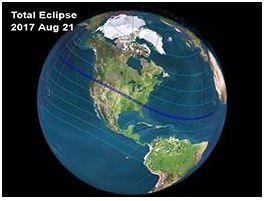
eclipses can be found on NASA’s Eclipse Web Site . It is possible for a solar eclipse to occur during school hours, in which case an observance can be held. Students will need to be taught that looking directly at the sun during a solar eclipse can be harmful to their eyes, but that there are other ways to view it. Students can learn how to watch a solar eclipse safely , and even make their own pinhole viewing devices! I hope these solar and lunar eclipse activities add to the learning experience.
Article Resources
Solar and Lunar Eclipse Webquest