The use of math and art for Leonardo Da Vinci was the cornerstone of one of his most recognized paintings. In these lesson plans, students learn about the Golden Rectangle, Golden Triangle and Golden Spiral as well as discuss how Fibonacci numbers fit into the world of art.
Phi and the Golden Ratio
Often, viewers ask why it is that the painting of the Mona Lisa draws them to her face and that mysterious smile. How did Da Vinci design his painting in just such a way as to cause onlookers to first look at the face, specifically the lips?
Da Vinci understood, like many other artists from ancient times through the 20th century, concept of the Golden Ratio. In fact, it was a concept on which he studied.
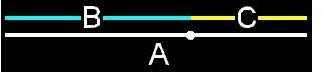
The Golden Ratio begins with Phi, an irrational number (1.618033988749895…). When used as the solution to a quadratic equation, Phi is the ratio of the line segments that result when a line is divided in one very special and unique way.
Therefore, (see diagram) the ratio of a line (A) to the length of a larger section (B) is the same as the ratio of (B) to the smaller section (C). This happens only at the point where A is 1.618 times B and B is 1.618 times C; alternatively C is 0.618 of B and B is 0.618 of A. (Note: Phi (upper case) is 1.618… and phi (lower case) is 0.618 or Phi minus 1.)
In the simplest of terms, The Golden Ratio is Phi squared or Phi plus 1. Using this formula, Leonardo Fibonacci discovered the mathematical series that can be witnessed in everything from DNA to seashells and from music to art and architecture.
Da Vinci and the Golden Rectangle
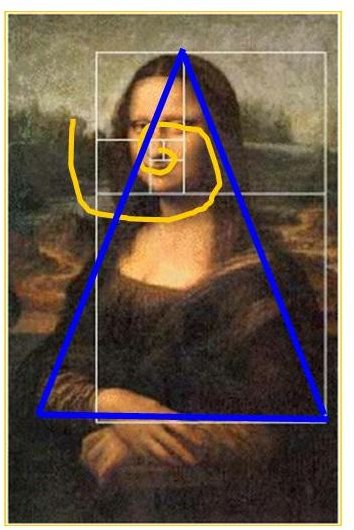
As can be seen in this picture of the Mona Lisa, Da Vinci appears to have used the Golden Rectangle to bring balance and depth into the painting. The Golden Rectangle was believed by artists to be the most aesthetically pleasing quadrangle. In addition to the Golden Rectangle, Da Vinci, a mathematician as well as an artist, used the Golden Triangle to draw attention to the Mona Lisa’s face. The Mona Lisa’s body from elbow to elbow to the top of the head forms the Golden Triangle. A triangle, by virtue of its shape, naturally draws the eye up.
Da Vinci further incorporated math in art by first placing a Golden Rectangle just above the Mona Lisa’s nose. By adding squares to the first rectangle using Fibonacci’s series (explained below), Da Vinci formed what is termed the Golden Spiral.
The large Golden Rectangle is thus formed. The base of the rectangle is formed by a line that extends from the wrist to the elbow. Its sides are formed by extending a line up to the top of the head.
While the Golden Rectangle is thought to be aesthetically pleasing, the Golden Spiral is thought to draw the person into a painting. Spirals naturally cause the eye to pull to the center.
Teachers in classrooms with computer access may want to go online to Wolfram Demonstration Project where students can manipulate a Golden Rectangle to discover the number of uses found for it in the Mona Lisa.
Fibonacci Fun
Utilizing manipulatives, classroom teachers can inspire students to discover firsthand how Leonard Da Vinci and other artists used math to create works of art. Manipulatives can be anything from UNIX cubes to buttons. Older students can use graph paper to accomplish this task.
Da Vinci used Fibonacci’s series to create within his Golden Rectangle, a Golden Spiral . (see diagram)
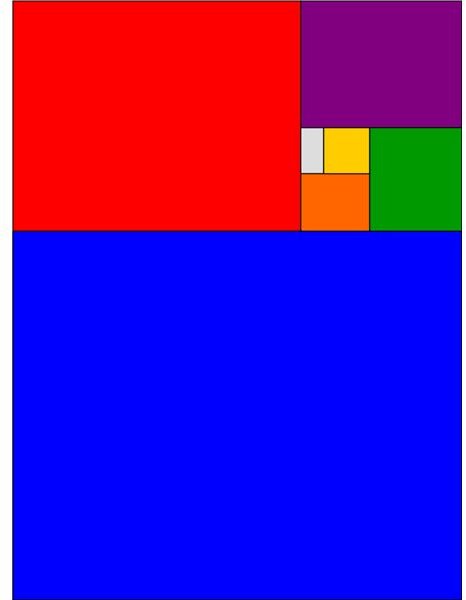
Students can create their own Golden spirals using manipulatives. The trick is to add each number to the one before it. Begin with 0 and 1. The result is 1, now, to that 1 and another 1. The result is 2. Add 1 plus 2 is 3, 3 plus 2 is 5, 5 plus 3 is 8 and so on. (0,1,1,2,3,5,8,13…)
The Golden Spiral is found throughout nature. Cut a nautilus shell in half, view the double helix of DNA or look at the center of a sunflower and you will see a Golden Spiral.
Educators can take this lesson one-step further by having students create in various art mediums examples of the Golden Spiral.
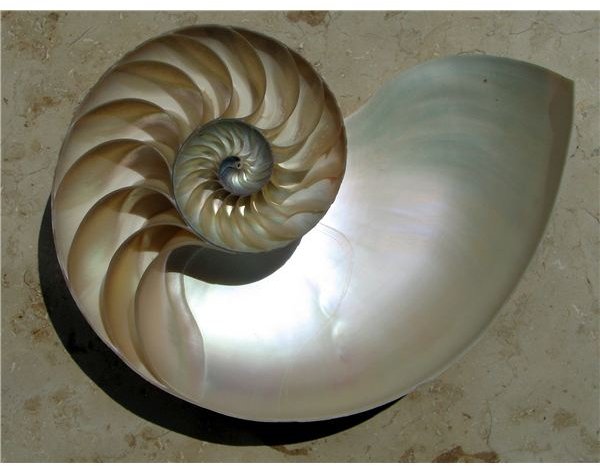
Dynamic Duo
Discovering the use of math in the art of Leonardo Da Vinci, as well as the art of others throughout history, can create enthusiasm for learning in students of all ages. Learning how mathematics is used to create portraits, landscapes and architecture brings math to life for even the most math-phobic student. From the Golden Ratio to Fibonacci numbers, there is a wealth of opportunity to discover, create and enjoy in math and art.
References
- University of Georgia: Golden Ratio/Di Vinci - http://jwilson.coe.uga.edu/EMT668/EMAT6680.2000/Obara/Emat6690/Golden%20Ratio/golden.html
- Wolfram: Mona Lisa and the Golden Rectangle - http://demonstrations.wolfram.com/MonaLisaAndTheGoldenRectangle/
- University of Surrey: Phi - http://www.maths.surrey.ac.uk/hosted-sites/R.Knott/Fibonacci/phi.html#golden
- Golden number: Phi and Fibonacci - http://www.goldennumber.net/
- Images: Phi Diagram, Mona Lisa/Golden Spiral and Rainbow Golden Spiral by Author; Nautilus Shell by Chris 73 under Creative Commons on Wikimedia Commons