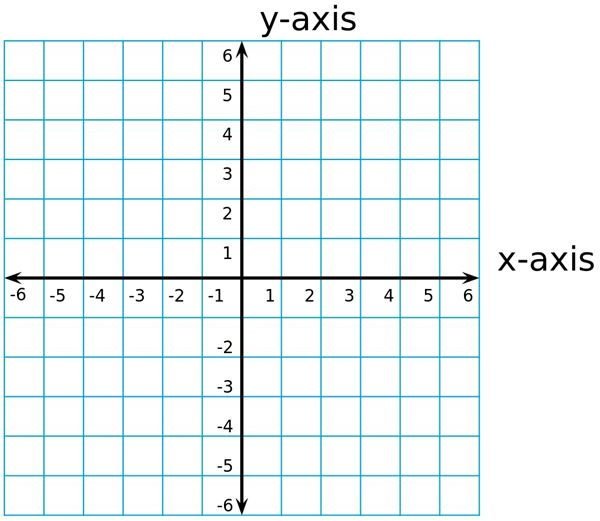
Give a no-pressure quiz and use humor to demonstrate how to represent ordered pairs on a coordinate plane.
**
Objective: Students will use data from a class quiz to learn how to locate and graph ordered pairs with positive and negative components.
CCSS.Math.Content.6.NS.C.6: Understand a rational number as a point on the number line. Extend number line diagrams and coordinate axes familiar from previous grades to represent points on the line and in the plane with negative number coordinates.
CCSS.Math.Content.6.NS.C.6b: Understand signs of numbers in ordered pairs as indicating locations in quadrants of the coordinate plane; recognize that when two ordered pairs differ only by signs, the locations of the points are related by reflections across one or both axes.
Materials: Overhead display, pre-selected quiz questions, paper, pencils, graph paper
Lesson Procedure
Step One: Introductory Activity
Explain to students that they will be taking a quiz. Fortunately, the quiz is for data purposes only, and will therefore be anonymous. Students will be encouraged to write fictitious names on their papers, which they will exchange for grading at the end of the quiz. (Note: depending on maturity level of students, you may want to set some guidelines for choice of names.)
Administer a 10-question quiz on a subject of choice, preferably one that is not related to math and will reveal many incorrect answers (narrow topics work well, such as “Beatles’ Songs” or “Chihuahua facts”). Include a few general, easy-to answer questions in the quiz so that students will get some practice graphing positive numbers as well.
When everyone has completed the quiz, have students trade and correct papers. They will need to be ready to share the number of correct and incorrect answers given on the papers they have graded.
Step Two: Demonstration of Procedure
Using the overhead, draw a graph with both positive and negative sides (with zero being the center of the graph). Explain that horizontal numbers will represent the number of correct answers (positive) on the graph, and the vertical numbers will represent the number of incorrect (negative) answers. For example, a student who got two correct answers and 8 incorrect answers will write the ordered pair (+2,-8), and will count two places to the right of zero on the horizontal line, and eight places below zero to place their dots on the graph.
Step Three: Creating Ordered Pairs and Graphing Data
Students will share the fictitious names written on the papers they have, and list the numbers of correct and incorrect answers for each quiz. After each student gives the numbers, students will follow along on their own graph papers, creating ordered pairs and plotting the numbers on the graphs.
Once the classroom data has been graphed, ask students to discuss what they see on the graphs, focusing particularly on the following questions:
- Where do most of the points fall?
- What is the likely reason for the points clustering in one region of the graph?
- How might the graph look if the quiz topic had been on a subject most students find familiar?
- How might teachers use such graphs as a tool when they have completed a unit of instruction?
Assessment: Ask students to flip their graph papers over and write a brief reflection on the day’s activity, noting points discussed in class and describing their own learning experiences. Collect papers to grade as assessment.
Extension: Expand graph lesson by incorporating it into future activities, giving students practice in using the negative quadrants of a graph when applicable.
This post is part of the series: Number Sense: Lessons and Activities for 6th Grade Math
In this series, we cover topics related to positive and negative numbers, absolute value, and number lines. We include suggestions for fun games and activities the whole class will enjoy!