Teach your students the real-life application of volume and surface area by designing and constructing their own cities!
**
Objective: Students will design and build a 3-D model of their own Ancient Roman city, and find the surface area and volume of its buildings.
CCSS.Math.Content.7.G.B.6 Solve real-world and mathematical problems involving area, volume and surface area of two and three-dimensional objects composed of triangles, quadrilaterals, polygons, cubes, and right prisms
Materials: Rulers, large pieces of paper, pencils, tape, compass (optional), markers or light paint, brushes and water
Step One: Introduce Activity
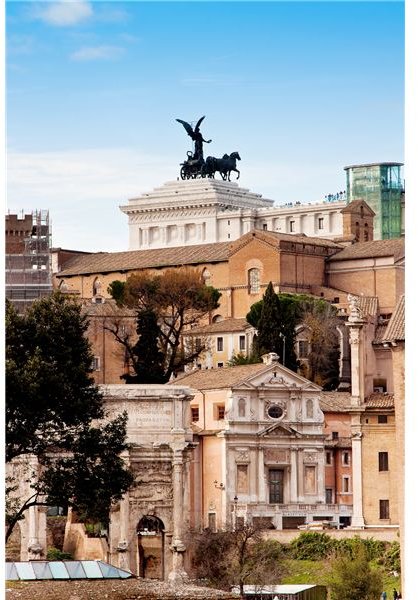
Show students several examples of Ancient Roman cities and buildings, both as reconstructed models and current ruins. Students will note characteristics of Roman buildings, and identify the 3-D shapes they see (rectangular prisms, cubes, cylinders).
Students will generate ideas for their own cities and decide which buildings or areas they would like to include (such as government buildings, temples, arenas, open marketplaces, homes, etc.).
Distribute large sheets of paper and ask students to draw basic blueprints for their cities, using rulers and compasses to create the shapes of the floors of their buildings. Students will need to label each building, and measure the dimensions of the floor of each building or designated area (such as an open marketplace).
Modification: For students who need extra guidance, you may want to hand out pre-drawn blueprints and ask students to measure the dimensions of the buildings as they are drawn on the paper.
Step Two: Create Real-Life Geometric Figures and Find Dimensions
Using the dimensions given for the floor of each building, students will create buildings out of paper to place in their cities. You may want to demonstrate the basic method for measuring and drawing out pieces to tape together to make cubes, rectangular prisms, and cylinders. Students can either decide on a height for their buildings before creating them, or create the buildings and measure them for height afterward.
For extra assistance, guide students who are using pre-drawn blueprints by helping them create their buildings from copies of sheets with the pieces for the buildings already drawn on them.
Once buildings are created, students can begin writing down and measuring the dimensions (height, length, width, radius, circumference) of each one, and begin filling in the following charts:
Once students have measured their buildings and filled the dimensions in on the chart, they can begin finding the surface area and volume of each building. Briefly remind students of the formula to find surface area and volume for each 3-d shape:
- Surface area of a cube: A= 6 (l ∙ w)
- Volume of a cube: V= (l ∙ w ∙ h)
- Surface area of a rectangular prism: A= 2(l∙w) + 2(w∙h) + 2(l∙h)
- Volume of a rectangular prism: V= (l ∙ w ∙ h)
- Surface area of a cylinder: A= 2 πr^2 + 2πr∙ h
- Volume of a cylinder: V= πr^2∙ h
Once students have completed their charts, they can begin decorating their cities and buildings with paint or markers.
Assessment: Collect students’ charts and assess the accuracy of their calculations based on the buildings’ measurements.
Extension: You may want to offer students the opportunity to write and solve real-world word problems using the measurements of their buildings, or encourage students to create a scale and calculate real-life dimensions of buildings and other parts of the cities.