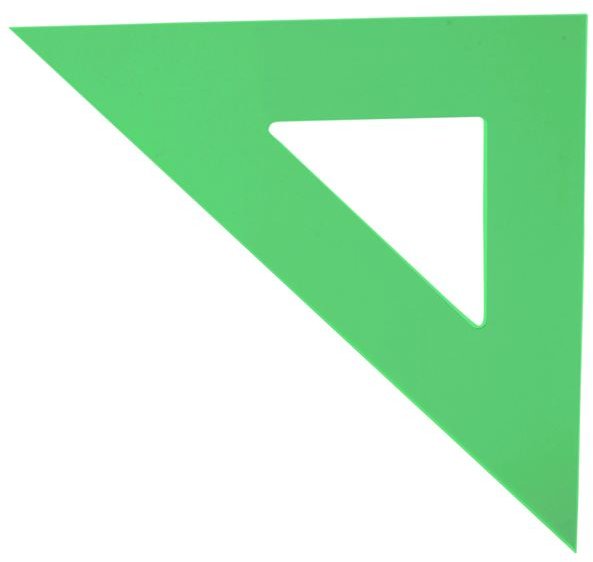
Let your students make the connection between hands-on methods and using the mathematical formula to find the area of a triangle!
**
Objective: Students will fold squares into triangles to discover and use the basic formula for finding the area of a triangle.
CCSS.Math.Content.6.G.A.1 Find the area of right triangles, other triangles, special quadrilaterals, and polygons by composing into rectangles or decomposing into triangles and other shapes; apply these techniques in the context of solving real-world and mathematical problems
Note: Students should be familiar with using a formula or hands-on method to find the area of rectangles and squares.
Materials: Large Paper, ruler, pencils, scissors
Step One: Introduction
Give students large sheets of paper, and ask them to draw a square measuring 6 inches x 6 inches. Demonstrate how to draw a grid using 1 x 1 inch squares on the large square to show the area as measured in square inches (total of 36 squares). (Tip: set a time limit for drawing grids so students stay focused). Ask the students to count the squares to find the area of the large square, and to discuss how the area relates to the dimensions of the square.
Students should make the connection that the area of the square (36 inches) can also be found by multiplying the length of the square by the width of the square. You can note the formula for area of squares and rectangles on the board (l ∙ w).
Step Two: Investigation
Ask students to cut the large squares out, setting extra paper aside for later. Once all of the students are holding their squares, ask students to make one fold in the squares to make two equal triangles. Students will cut their squares in half along the diagonal, so that they are holding two triangles.
After cutting out their triangles, students will be asked to estimate the area of the triangles by counting the squares on the grid. They should make their best guesses as to the area of each triangle, adding half squares or quarter squares to the best of their abilities.
Stop class for a brief discussion, during which students should conclude that the area of each triangle is somewhere close to 18 square inches. When adding the area of both triangles, students should note that the total square inches comes to 36, the original area of the square.
Step Three: Small Group Discussion
Pose the following questions (on the board or on paper) for students to discuss in small groups (or with partners):
1) Is it accurate to count the grid squares to find the area of a square? Of a triangle? Why or why not?
2) If you know the dimensions of a square, can you find the area of a triangle that is half the size of the square? How?
3) What do you think the formula for finding area of a triangle might be? Explain your reasoning.
After the peer discussion, invite students to share their answers in a quick group discussion. You can then share the formula for area of a triangle: ½ b ∙ h.
Step Four: Application of Skill
Ask students to use their leftover paper to repeat the previous activity, this time with measurements other than 6 x 6 for their squares. After determining the area of their squares, students should use the formula for area of a triangle to find the area of the two triangles they will make when after folding their squares in half. They should then proceed with folding and cutting out their triangles and counting the grid squares to estimate the area of each triangle.
While your students are working, post several drawings of squares on the board and include their theoretical dimensions (they do not need to be to scale), so that students can practice finding the area of the two triangle included in each square by using the formula ½ b ∙ h.
Extension: You may want to give students homework or guided work for the next day to reinforce the skill of using a formula to find the area of triangles made from folding squares in half.