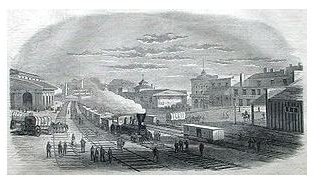
The fall of Atlanta, Georgia, was the fulfillment of General Sherman’s mission.That mission, as stated by Sherman’s superior, General Grant, was to inflict “all the damage you can against (the South’s) War resources.” This lesson plan focuses on the fall of Atlanta and its importance to the Union.
Background
Massing an army of about 100,000, Union General William Tecumseh Sherman left Chattanooga, Tennessee. His orders were to “move
against Johnston’s army, to break it up, and to get into the interior of the enemy’s country. On May 6, 1864, as Grant and Lee struggled in Virginia, Sherman went for Confederate General Joe Johnston.
General Johnston’s tactics were to fight and fall back before the superior Union force could flank him. Figuring that he could stretch Sherman’s supply lines and simply wear our the Union war machine, Johnston’s strategy was to hold out until the North’s November elections and possible defeat of Abraham Lincoln. Confederate President Jefferson Davis saw it differently, though. Never an admirer of Johnston’s tactics of constant retreat, Davis replaced Johnston with a more aggressive, but far less competent General John Bell Hood. Hood would fight and confront the Union army that had encircled Atlanta, but his brave Rebels were like waves crashing on the rocks of the superior Yankee force.
After three bloody and hard-fought battles, General Hood was forced to evacuate Atlanta. Hood went North to attack (and be defeated at) Franklin, Tennessee, hoping to lure the larger, but slower Yankee army away. Sherman occupied Atlanta for a month and burnt the city after ordering the citizens to leave.
Instead of pursuing Hood, Sherman decided to march his Army east to the Atlantic. By the time he emerged in the coastal city of Savannah, Sherman’s army would strip Georgia bare of food, livestock and its ability to resist the Union.
More Background and Facts
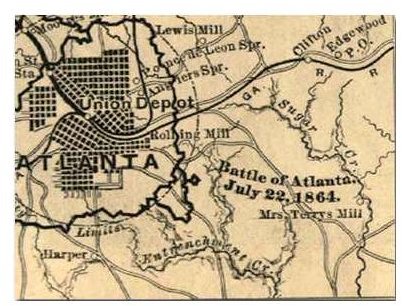
Location: Atlanta, Georgia
Inclusive Dates: July 20 - September 2, 1864
Outcome: Union Victory
Casualties: (July 22, 1864, Battle of Atlanta) Union: 3,461 (Included Union General James McPherson); Confederacy: 8,499 (Included Confederate General W.H.T. Walker)
Significance:
Atlanta, Georgia, was an important southern rail hub and a manufacturing center for munitions and steel. When General Hood abandoned Atlanta, Sherman had effectively crushed the Southern war machine (Lee would surrender in Virginia six months later). Even more devastating to Southern hopes was the precipitous weakening of the Northern peace movement and the crippling of the Democrat challenge to Lincoln’s reelection.
Confederate Defeats that Led to the Fall of Atlanta
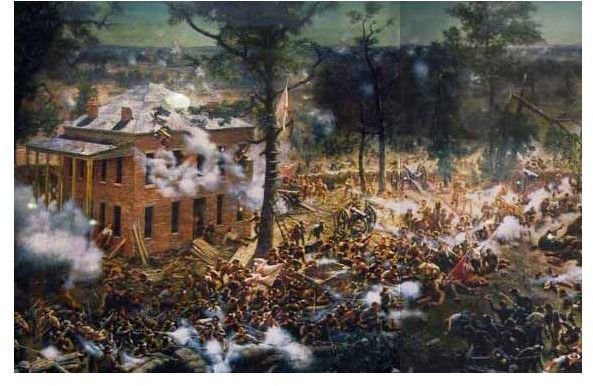
July 20, 1864 - The Battle of Peachtree Creek
♦ Read about the Battle of Peachtree Creek on the American Civil War site.
July 22, 1864 - The Battle of Atlanta
♦ Read about the Battle of Atlanta at About North Georgia’s web site, “The Battle of Atlanta .”
July 28, 1864 - The Battle of Ezra Church.
♦ Read about the Battle of Ezra Church at History of War.Org, “Battle of Ezra Church ”
Classroom Activity
Background:
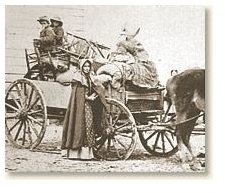
One eyewitness account of the plundering Yankee army’s march through Georgia is on Eye Witness to History’s web page “Sherman’s March to the Sea, A Southerner’s Perspective. ” This account is by Dolly Sumner Lunt, a transplanted northerner and widow, whose farm was in the path of Sherman’s troops.
Assignment:
Have students read and discuss Dolly’s scary account of the invading Yankee army and its effect on the civilian population. Suggested items/questions for discussion:
♦ Describe some of the terrible things that Sherman’s men did to Dolly’s property.
♦ Why did the Yankees force Dolly’s slaves to leave? How did some of the slaves react?
♦ Were the Yankees justified in destroying property and stealing food and livestock?
♦ After Sherman’s army passed through, how did Dolly feel about the southern cause?
This post is part of the series: Pivotal Battles of the Civil War
This is a series of articles on U.S. Civil War battles that were pivotal to the eventual Union victory. Read about the battles at Shiloh, Antietam, Gettysburg, Vicksburg and the fall of Atlanta. Each of these battles played a key role in the outcome of our nation’s bloody and protracted civil war.