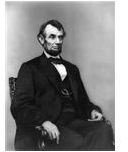
On March 4, 1865, Abraham Lincoln delivered his second inauguration address. The Civil War was about to end, and Lincoln wanted to set the tone for national reconciliation. This lesson plan focuses on important aspects of Lincoln’s speech, which analyzed the causes of war.
Introduction
As Abraham Lincoln began his second term, the country was devastated by a four-year civil war that had been far longer and bloodier than
anyone could have imagined. The South lay in ruins as General Robert E. Lee moved the remnants of the Confederate Army of Northern Virginia to Appomattox. Hopelessly outnumbered and surrounded, Lee would surrender to Union General Ulysses S. Grant. The war would end within about five weeks of Lincoln’s speech, and Lincoln would be assassinated less than a week later after that surrender.
Anticipating the impending end of the war, Lincoln realized that his most important task at hand was “to bind up the nation’s wounds.” Four years earlier, Lincoln’s first inauguration speech focused closely on the unionist view of secession and begged the South to reconsider secession. His second inauguration speech, though, was much shorter, but carried only a hint of a victor’s satisfaction. Significantly, this speech differed in tone and approach than his first address: It showed Lincoln’s profound spirital belief that God had a hand in the whole affair.
Learning Objectives
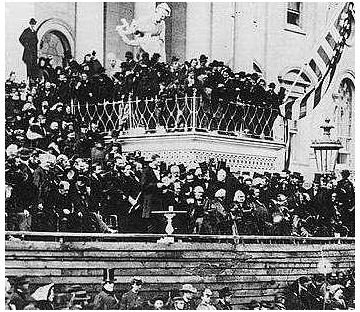
After completing this lesson plan, students should be able to understand Abraham Lincoln’s views that:
♦ slavery was “somehow the cause of the war;
♦ those who fought against the Union wanted to extend slavery, whereas the U.S. Government wanted only to restrict slavery’s “territorial enlargement”;
♦ the Civil War was “an offence” against God that resulted in “the scourge of war” in which the North and the South both suffered;
♦ the country needed to “bind up the nation’s wounds” and care for those who were suffering to gain “a just and lasting peace.”
Resource Material
President Lincoln’s First Inaugural Address from Bartleby.com
Abraham Lincoln Online: Abraham Lincoln’s Second Inauguration
Class Activities
Print the annotated excerpt of Abraham Lincoln’s Second Inaugural Speech for use either as:
♦ An in-class handout and discussion,
or
♦ A homework reading and short-answer writing assignment.
Download the annotated speech and answer key.
Download a Word file of the speech, followed by an answer key to the questions at “President Abraham Lincoln’s Second Inaugural Address” posted on the public media gallery.
Related Bright Hub Article
Lesson Plan for History: The First Inauguration Speech of Abraham Lincoln
This post is part of the series: The Speeches of Abraham Lincoln
Abraham Lincoln’s speeches passionately articulated why he believed that secession and the resulting Civil War were both a test of our republic and somehow part of a “divine plan” that involved penance for slavery. This series introduces students to Lincoln’s most famous speeches.