Advertisement
More

Basic Math Formulas: Practice Made Easy

Math becomes exponentially easier once you practice and master some basic formulas.

By Trent Lorcher
Desk More
Reading time 3 min read
Word count 581
Help with math homework Homework help & study guides
Basic Math Formulas: Practice Made Easy
Advertisement
Quick Take

Math becomes exponentially easier once you practice and master some basic formulas.

On this page

To Memorize or Not to Memorize

Once you master basic math formulas you’ll find finishing homework and acing tests much easier. Memorization is not enough and may not even be necessary for mastery. Mastery involves knowing when and how to use a formula. For example, you might be asked to find the area of a triangle (yes, there are real world applications for this; trust me), and since you memorized the formula for the area of a rectangle and used it, your calculations are way, way off.

Although memorizing a formula can make your life easier, you don’t need to memorize them to master them. You will discover, however, that frequent use of a formula will lead to memorization.

Advertisement

By the way, if your math teacher requires you to memorize formulas–notwithstanding that people in the real world use charts and (gasp!) cheat sheets in case they forget–humor him or her and memorize the darn things, while keeping in mind what’s most important: mastery.

Geometric Shapes: Basic Formulas

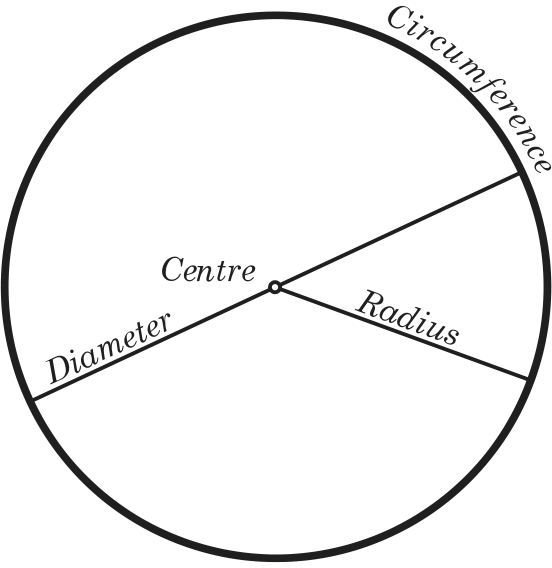
Circle

Advertisement
  • Area = ∏r2
  • Circumference = 2∏r

Square

  • Area = length * width
  • Perimeter = 4 * length

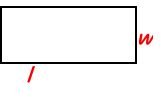
Rectangle

Advertisement
  • Area = length * width
  • Perimeter = 2*length + 2*width

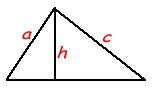
Triangle

  • Area = 1/2 * base * height
  • Perimeter = a + b + c
  • Pythagorean Theorem (right triangles only) - a2 + b2 = c2

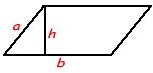
Parallelogram

Advertisement
  • Area = base * height
  • Perimeter = 2*a + 2*b

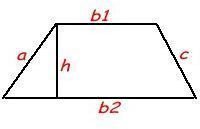
Trapezoid

  • Perimeter = side a + side b1 + side b2 + side c
  • Area = height * (side b1 + side b2) / 2

**

Advertisement

rectangle

triangle

Advertisement

parallelogram

trapezoid

Advertisement

Three Dimensional Formulas

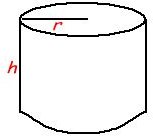
Cylinder

  • Surface Area = (2 * ∏ * r2 ) + (2 * ∏ * r * height)
  • Volume = ∏ * r2 * height

Cube

Advertisement
  • Surface Area = 6 * length2
  • Volume = length3

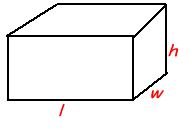
Three dimensional Rectangle

  • Surface Area = 2 *length * width + 2 * length * height + 2 * width * height
  • Volume = length * width * height

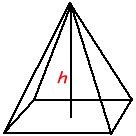
Pyramid

Advertisement
  • Volume = 1/3 base * height

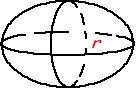
Sphere

  • Volume = 4/3 * ∏ * r3
  • Surface Area = 4 * ∏ * r2

cylinder

Advertisement

3 dimensional rectangle

pyramid

Advertisement

sphere

Basic Algebra Formulas

  • xa * xb = xa+b
  • (xa)b = xab
  • (xy)a = xaya
  • (x+y)2 = x2 + 2xy + y2
  • (x-y)2 = x2 - 2xy - y2

Other Math Formulas

  • Quadratic Formula
    Quadratic Formula
    Converting a Fraction to a Decimal - Numerator / Denominator
  • Slope of a Line - rise / run
  • Slope Intercept Form - y = mx + b (if you don’t know what this means, go here for an explanation)
  • Quadratic Formula - Given the formula ax2 + bx + c = 0, x can be solved with the following equation:

Solving Problems

Knowing and understanding the above formulas should be sufficient for passing any standardized math test, assuming you know when to use them. When determining which formula to use, make sure you read the question carefully and understand exactly what it is asking; otherwise, knowing the formula will do you no good. Once you understand what the question is asking and determining which formula to use, be sure to list all necessary information.

Advertisement

The next article in this series will give you a step-by-step explanation on how to solve math problems.

This post is part of the series: Solving Math Problems the Easy Way
Math isn’t as hard as you think it is.

Advertisement
  1. Formulas to Practice Basic Math
  2. Math Help: Problem Solving Steps
  3. How to Solve Any Math Problems in Seconds
  4. Easily Find the Diameter of a Circle
Keep Exploring

More from More

Egyptian Death: Mummy Kitty

Egyptian Death: Mummy Kitty

A century is one hundred years and the civilization of the Egyptian people was nearly 30 centuries long. The unification …

Storming of the Locusts

Storming of the Locusts

You’ve seen the funny little grasshopper. He has big eyes, long feelers called antennae, and legs that are kind of bent …

Filed under
Help with math homework
More topics
Homework help & study guides
Advertisement