After learning about differentiation and being introduced to integration as a complex way of doing sums, it is crucial to bring these two concepts together. The relationship between them form the Fundamental Theorem of Calculus, which allows us to evaluate integrals more efficiently than before.
In all introductory calculus courses, differentiation is taught before integration. However, the two are brought together with the Fundamental Theorem of Calculus, the principal theorem of integral calculus. This theorem allows us to evaluate an integral by taking the antiderivative of the integrand rather than by taking the limit of a Riemann sum. Newton and Leibniz utilized the Fundamental Theorem of Calculus and began mathematical advancements that fueled scientific outbreaks for the next 200 years.
Note: I will be including a number of equations in this article, some of which may appear small. If you have difficulties reading the equations, you can enlarge them by clicking on them.
The Fundamental Theorem of Calculus Part 1
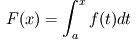
If f(t) is integrable over the interval [a,x], in which [a,x] is a finite interval, then a new function F(x) can be defined as:
For instance, if f(t) is a positive function and x is greater than a, F(x) would be the area under the graph of f(t) from a to x, as shown in the figure below:
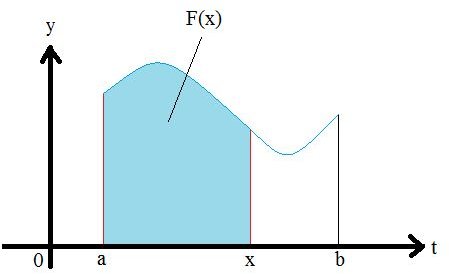
Therefore, for every value of x you put into the function, you get a definite integral of f from a to x.
The equation above gives us new insight on the relationship between differentiation and integration. If f is a continuous function, then the equation above tells us that F(x) is a differentiable function whose derivative is f. This can be represented as follows:

In order to understand how this is true, we must examine the way it works. If f ≥ 0 on the interval [a,b], then according to the definition of derivation through difference quotients, F’(x) can be evaluated by taking the limit as h→0 of the difference quotient:
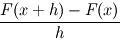
When h>0, the numerator is approximately equal to the difference between the two areas, which is the area under the graph of f from x to x + h. That is:

If we divide both sides of the above approximation by h and allow h→0, then:

This is always true regardless of whether the f is positive or negative. Therefore, it embodies Part I of the Fundamental Theorem of Calculus.
Applying The Fundamental Theorem of Calculus Part 1
Using the fundamental theorem of calculus, evaluate the following:
a)
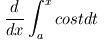
b)
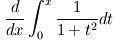
Solutions
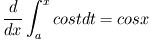
a) If we let f(t) = cost, then:
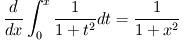
b) If we let f(t) = 1/(1 + _t_2), then:
The Fundamental Theorem of Calculus Part 2
In Part 1 of the Fundamental Theorem of Calculus, we discovered a special relationship between differentiation and definite integrals. Therefore, we will make use of this relationship in evaluating definite integrals.
Firstly, we must take note of an important property of integrals:
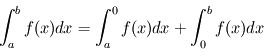
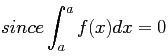
This can be simplified into the following equation:
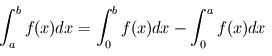
Using our knowledge from Part 1 of the Fundamental Theorem of Calculus, we further simplify the above equation into the following:

The above relationship is true for any function that is an antiderivative of f(x). For instance, if we let G(x) be such a function, then:

We see that when we take the derivative of F - G, we always get zero. This must mean that F - G is a constant, since the derivative of any constant is always zero. Therefore, we can say that:

This can be simplified into the following:

Therefore, F(x) can be used to compute definite integrals:

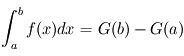
We now have the Fundamental Theorem of Calculus Part 2, given that f is a continuous function and G is an antiderivative of f:
Applying The Fundamental Theorem of Calculus Part 2
Evaluate the following definite integrals
a)
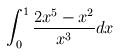
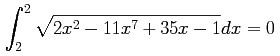
b)
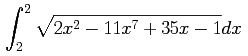
Solutions
a)
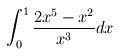
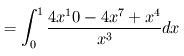
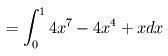
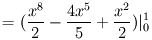
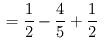

b)
Textbook Reference
Thomas’ Calculus.–Media upgrade, 11th ed. / Joel Hass…[et al.].