You struggled through the play and now your teacher wants you to understand the major themes of Hamlet. You’ve racked your brain trying to analyze Hamlet themes but you’re just not sure you get it. I’ve got great news. I can help.
The Mystery of Death
“To be or not to be?” (III, i, 55) Writers and speakers make frequent allusions to Shakespeare’s most famous soliloquy. Most, however, don’t know what the soliloquy is about. You do. It’s about whether or not death is preferable to life. Hamlet ponders whether or not it would be better to kill oneself than to pass through life’s trials. He all but concludes death would be preferable if not for the following: he has no idea what exists beyond death and that there is no way to return from death.
This is not Hamlet’s first contemplation of what lies beyond death. He laments, “Oh, that this too too solid flesh would melt / Thaw and resolve itself into a dew!” (I, ii, 129-30). Hamlet expresses his desire to die in reaction to the hasty marriage of his mother after his father’s death. What prevents Hamlet from taking action and ending it all? He is uncertain what the end of life holds.
Hamlet philosophizes the end of all humans as he looks upon gravediggers in Act V, theorizing that the greatest of kings are nothing more than hole pluggers after they die. Hamlet wonders if anything exists after death, a belief that stays him from taking his own life, a life he feels is full of sorrow and pain. He is further agitated by the thought of death as he holds dead Yorrick’s skull.
Rotten Leadership Leads to a Rotten Nation
“Something is rotten in the State of Denmark” (I, iv, 67) is a reference not only to the treasonous acts of Claudius and the looming madness of Hamlet; it refers to the civil strife that has enveloped the nation. The situation is worsened by Hamlet’s inability to act, unlike Fortinbras: Fortinbras is decisive. Hamlet is not. Fortinbras is a man of action. Hamlet is a man of thinking. Fortinbras resembles Hamlet’s father more than Hamlet’s uncle or Hamlet himself. Hamlet seems to have recognized Fortinbras’ ability to lead by naming him the rightful ruler of Denmark at the play’s conclusion.
Absolute Certainty is Impossible
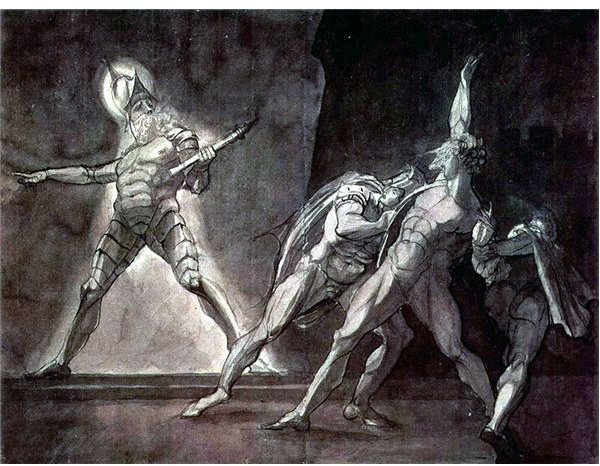
Hamlet’s indecisiveness is a direct result of his inability to obtain absolute certainty. He sees a ghost that looks like his father, but it could be the devil in disguise. Claudius is agitated by the players’ performance, but it could be a reaction to a nephew killing an uncle, or it could be a natural reaction to being accused of murder. The Hamlet theme that absolute certainty cannot be attained is further heightened by Hamlet’s inability to understand death.
This post is part of the series: Hamlet Study Guide
Review Shakespeare’s greatest play with the Hamlet Study Guide.