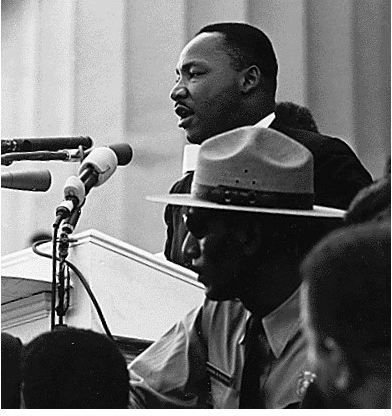
King’s use of metaphors in his “I Have a Dream” speech sheds light on what accomplishing the American Dream means. We look at some brilliant examples of metaphors in specific well-known quotes, and provide analysis.
Martin Luther King’s “I Have a Dream” speech has taken its place among the pantheon of great and important American speeches. Its brilliance, however, goes beyond its historical significance. King’s use of figurative language makes it an excellent example on the effective use of metaphors.
Weather Metaphors
The opening of King’s speech uses metaphors to compare the promises of freedom made in the Declaration of Independence, the Constitution and the Emancipation Proclamation and the failure of these documents to procure those freedoms for all. He then turns to a metaphor familiar to all–the weather.
Quote: “This sweltering summer of the Negro’s legitimate discontent will not pass until there is an invigorating autumn of freedom and equality.”
Metaphor: King compares the legitimate anger of African-Americans to sweltering summer heat and freedom and equality to invigorating autumn.
Analysis: Anyone who’s visited Washington D.C. in August has a keen understanding of what a “sweltering summer” produces–frustration, suffering, restlessness and a longing for relief. The hundreds of thousands in attendance would have clearly understood the implications of the need for relief from a sweltering summer day and the need for legislation that would procure rights for minorities; relief that began to arrive with the Civil Rights Act of 1964.
Quote: “I have a dream that one day even the state of Mississippi, a state sweltering with the heat of injustice, sweltering with the heat of oppression, will be transformed into an oasis of freedom and justice.”
Metaphor: King compares injustice and oppression to sweltering heat and freedom and justice to an oasis.
Analysis: King repeats the sweltering heat metaphor toward the end of the speech, referring specifically to Mississippi, a state where some of the worst offenses against blacks had been carried out. By specifying states in the south (he also mentions Georgia, Tennessee, Alabama, and the South in general) and mentioning the oasis that awaits even these places, King magnifies his message of hope to those suffering the most.
Quote: “The whirlwinds of revolt will continue to shake the foundations of our nation until the bright day of justice emerges.”
Metaphor: King compares what the Civil Rights movement will produce if their demands are not met to a rapidly rotating, destructive vertical column of air. He compares the day when these rights are procured to a “bright day of justice.”
Analysis: Whereas King’s first weather metaphor involves a natural progression of events–summer to fall–his second weather metaphor involves violence, destruction, and an inevitable end to the violence and destruction. Martin Luther Jr., it must be noted, is not promoting violence but summarizing the feelings of frustration that have enveloped the throngs of minorities to whom the aforementioned promises of the Declaration of Independence and other American documents had not been fulfilled.
King’s use of weather metaphors emphasizes the reality of the movement–that it’s a force that cannot be controlled and that must manifest itself through the acquisition of equal rights.
King and the Higher Law
King’s philosophy of love and brotherhood permeate his speeches…and his metaphors. These metaphors from King’s “I Have a Dream” Speech allude to the necessity of maintaining such an attitude.
Quote: “Let us not seek to satisfy our thirst for freedom by drinking from the cup of bitterness and hatred.”
Metaphor: King compares freedom to a thirst quenching draught and hatred to a cup of bitterness.
Analysis: King’s understanding of the plight of African-Americans in the 1960s gave him the ability to shape the Civil Rights movement. He undoubtedly understood the potential for the movement to turn violent. Having himself suffered racial injustice, King, better than most, understood how easily hatred and bitterness could engulf the entire movement, making the seekers of justice as unjust as the oppressors.
Quote: “We must forever conduct our struggle on the high plane of dignity and discipline. We must not allow our creative protest to degenerate into physical violence. Again and again we must rise to the majestic heights of meeting physical force with soul force.”
Metaphor: King compares facing the struggle for equality with dignity and discipline to entrenching oneself on the “high plain” and the meeting of physical force with “soul force” to rising to “majestic heights.”
Analysis: King stayed true to his core principles of peace and love, notwithstanding the violence and hatred he confronted. He urged his followers to do the same. These “majestic heights” King desired could only be achieved through love.
Quote: “With this faith we will be able to transform the jangling discords of our nation into a beautiful symphony of brotherhood.”
Metaphor: King compares racial inequality to the “jangling discords of our nation” and the achievement of equality as a “beautiful symphony of brotherhood.”
Analysis: Although there are no metaphors in King’s “I Have a Dream Speech” that make direct reference to the Bible, it must be noted that King was a Baptist minister and had a thorough understanding of the Bible, whose teachings permeate King’s speeches and, more importantly, his actions. He, therefore, understood the power of faith and was influenced by the New Testament’s emphasis on love and brotherhood, a brotherhood that could only be realized when humans were afforded equal opportunity and standing under the law.
In addition to being a man of God, King understood the importance of establishing one’s place among men in the quest for racial equality, a place that could be established through material wealth. He, therefore, sprinkles numerous metaphors regarding money throughout the speech. A thorough explanation of these can be found in the “I Have a Dream” study guide .
References
- The I Have a Dream Speech, http://www.usconstitution.net/dream.html
- Image: Martin Luther King - March on Washington , Author: Unknown/Wikimedia Commons