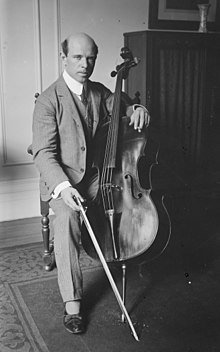
A sound wave with a high frequency vibrates more rapidly than a sound wave at low frequency. And typically, a vibrating string produces very little sound unless the string instrument has a sounding board. Pau (Pablo) Casals could make a cello weep, dance, and the strains of his music could alter your day. He was that good!
A sound wave with a high frequency vibrates more rapidly than a sound wave at low frequency. And typically, a vibrating string produces very little sound unless the string instrument has a sounding board. Pau (Pablo) Casals could make a cello weep, dance, and the strains of his music could alter your day. He was that good!
Instrument Notations
Towering 6’5″ cellist Amit Peled, is a highly acclaimed cello performer and aficionado who teaches at the Peabody Institute. From 2012 through 2018, Peled performed on the Pablo Casals Goffriller cello—made by master luthier Matteo Goffriller in 1733—which was loaned to him personally by Casals’ widow, Marta Casals Istomin.
He once said about the experience of playing on Casal’s cello: “To be honest, it really teaches me colors that I didn’t know existed. It’s like when you drive on a highway and your GPS tells you to take an exit—but it doesn’t capture all the available exits, and only shows you one option. This cello captures the ways you didn’t know existed. And your curiosity takes you to all those different routes. This cello tells me to take different paths, and I enjoy that.”
In fact, Peled was so enamored with playing one of the most famous instruments of all time that his journey from playing basketball in rural Israel to being in the greatest concert halls is the subject of the children’s book, A Cello Named Pablo.
Pablo’s Beginnings
Who was this man who inspired so many and how did he change the face of music with the cello?
Pablo Casals was born December 29, 1876, in a semi-autonomous region in the northeast of Spain, Vendrell, Catalonia, an area that has a separatist history dating back almost 1,000 years. He was the second of a large family of eleven children. Music was a part of his life even as an infant when his father, the local church organist, would rest the baby near the piano so that at the age of four Pablo was playing the piano, and at six he was composing songs with his father! At nine he could play the violin and organ and, after a daily walk, would play two classical Bach pieces on the piano when he returned home.
When Pablo saw the cello at a recital, his father built him one—not a small task that!
Cello Master
At the Municipal School of Music in Barcelona, Pablo’s ideals about playing often contrasted with the strict instructor’s rules. Even so, his degree of skill grew to a formidable style and he went from supporting himself by playing in local cafes to assuming a royal scholarship to the Madrid Conservatory in 1893, at age 17.
His performances took on many adaptations, from the Folies-Marigny music hall in Paris, to notable chamber ensembles and even an orchestra Casals founded in 1919 as the Orquestra Pau Casals in Barcelona. With this new orchestra, he hired musicians, invested his own money, and raised the level of technical accomplishment of all the players. It took a tremendous toll on him however, in that he suffered a nervous breakdown and at one point, and had to recuperate away from the business. Through his efforts though, Orquestra eventually became one of the finer orchestras in Europe, attracting high-level talent and guest conductors.
Working Men’s Concert
Casals believed that orchestral performances should appeal to the working-class of Catalonia and was dedicated to the idea that families should attend Mozart, Beethoven and other classical repertoire, at reasonable subscription prices.
As the first modern cello virtuoso, Pablo Casals created a new appreciation of the instrument and its repertory, at a time when the concert stage was still considered the exclusive playground of the piano and violin. The twentieth century was made richer by his radical approach to a unique bow and finger technique. The positioning and strength produced by left-hand shifting techniques which were typically used only by violinists, gave a deft agility never known for the cello previously. He considered it the artist’s responsibility to achieve intense concentration and extreme virtuosity.
When Pablo was only 14, sometime in 1890, he and his father were in a Barcelona bookstore where they happened upon a volume of Bach’s six suites, which were thought to be musical exercises for cello with no musical warmth or artistic value. Casals brought them to life after practicing and perfecting them every day for twelve years before performing them for others.
Pablo Casals died October 23, 1973 in his home in San Juan, Puerto Rico.
Reference:
Macaulay, David. The Way Things Work: Musical Instruments. Millimages, Pearson Broadband and Schlessinger Media. 2003. DVD.
McKean, James N. Commonsense: Instrument Guide; Strings: How to Look after Your Violin, Viola or Cello, and Bow. San Anselmo, CA: String Letter Publishing, 1996. Book.
Nunn, Daniel. Strings: Instruments and Music. Chicago, IL: Heinemann Library, 2012. Book.
10 Interesting Facts about the Cello [Amit Peled
](http://www.amitpeled.com/biography)[Encyclopedia
of World Biography
](https://www.notablebiographies.com/Ca-Ch/Casals-Pablo.html)[Goffriller
](https://tarisio.com/cozio-archive/browse-the-archive/makers/maker/?Maker_ID=1473)[Listen
to Casals play J. S. Bach
](https://www.youtube.com/watch?v=ePPMrX4YtkM)[Pablo
Casals Made Bach’s Cello Suites Famous
](https://www.wbur.org/artery/2019/10/18/cellists-boston-pablo-casals)[String Ovation: A Brief History of the Cello](https://www.connollymusic.com/stringovation/a-brief-history-of-the-cello )
Strings. “Cellist Amit Peled on Practicing & Performing with Pablo Casals’ Goffriller Cello.”
Casals in 1917 at Carnegie Hall This image is available from the United States Library of Congress Prints and Photographs division Public Domain