Presently occupying 10 percent of the Earth’s land mass, glaciers are, themselves, areas of thick land massed made up of layers of compressed snow and ice. But where do glaciers form? And what impact do they have on our environment?
The Science Behind Glaciers
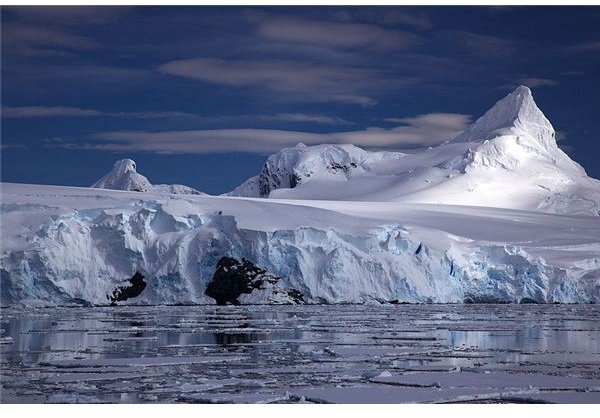
When you think of glaciers, you may picture mountain-like peaks that rise out of the water. But it may be surprising to know that only approximately 10 percent of the glacier is actually above water. That other 90 percent is submerged, and glaciers store about 75 percent of the Earth’s supply of fresh water.
While it can take up to 100 years for a glacier to form, accumulated snow that remains in the same area year-round provides the right conditions for its growth.
As the snow accumulates year after year, the previous layers are compressed and form into small sugar-like grains. As the grains continue to grow, any air pockets get smaller, allowing the crystals to compact and become more dense. This density of the ice is why glacier ice sometimes appears blue.
There are a variety of glacier types and the places they form vary as well.
Alpine Glaciers
Alpine (or mountain) glaciers include varieties that form directly on mountains, while continental glaciers, also known as ice sheets, cover the terrain surrounding it. See more on continental glaciers below.
Mountain Glaciers
Mountain glaciers are smaller glaciers that form at higher altitudes and often occupy the naturally-found crevices or depressions found on the sides of mountains.
Valley Glaciers
These types of glaciers look like frozen rivers of water extending down the sides of mountains, sometimes all the way down to sea level.
Cirque Glaciers
Another type of glacier that forms on mountains, these ones fill in bowl-shaped impressions and are wider, as opposed to being long like the Valley Glaciers.
Continental Glaciers
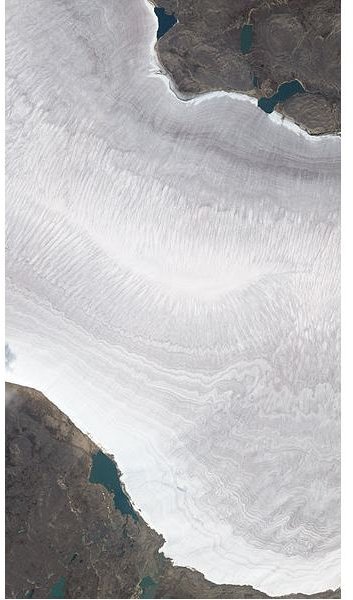
These glaciers cover at least 19,000 square miles (50,000 sq km) of land. While Valley Glaciers flow downhill within the confines of a valley and sculpt the land into rugged terrain, Continental Glaciers flow outward in all directions, often smoothing out the land beneath it.
Ice Sheets
Massive expanses of ice that are over 19,000 feet (50,000 sq km) are known as Ice Sheets. Currently, the only Ice Sheets are found in Antarctic and Greenland.
Ice Shelves
Ice Sheets that extend from the land and float on the water are known as Ice Shelves. Most of Antarctica is surrounded by Ice Shelves.
Ice Caps
Ice Caps are relatively flat and cover less than 19,000 square miles of land area.
The Effects of Melting Glaciers on the Environment
In a 2007 article by Blake DePastino, National Geographic Magazine reported that mountain glaciers are melting faster than ever.
When glaciers melt, they leave lakes where before there was open land. This can have a negative impact on plants and animals that are native to that region.
How Animals Are Affected
In the Arctic, six different species of seals rely upon ice for their survival. A decrease in sea ice means they have a reduced habitat. If ice breaks up prematurely, this can result in a separation of mother seals and their pups.
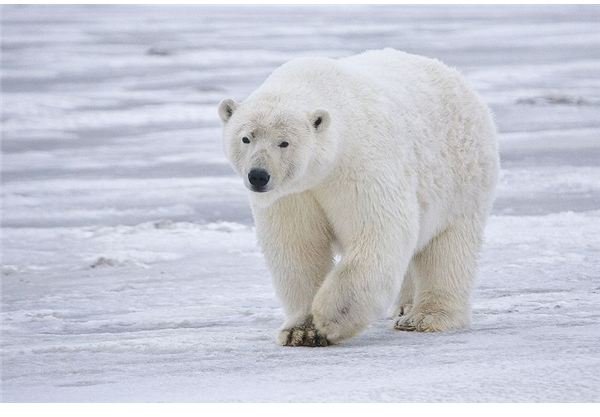
Melting ice also has a negative impact on polar bears that live in the Arctic. When the ice melts too soon, the bears are forced to move to land sooner than they normally would. This can mean they will not have enough fat reserves to survive the warmer months.
The Impact of Rising Temperatures on Glaciers
Snowfall, rain and avalanches are important factors in the survival of glaciers. But with warmer global temperatures, glaciers are not only melting, but at a much more accelerated rate, which causes the potential for flooding.
With less ice , the Earth absorbs more heat, thus causing our temperatures to rise, which contributes to melting and the rising of the sea levels.
By studying the Arctic Sea Ice, we can see that our ice caps have continued to steadily decline, which directly effects global temperatures, people and animals.
Further Reading
- Melting Greenland Glaciers Continue as Global Warming Intensifies
- Melting Glaciers and the Release of Methane
- Science Lab: Modeling a Glacier
Sources
- National Snow And Ice Data Center
- Earth Science Australia
- All About Sea Ice
- Photos: Jason Auch , Alan D. Wilson , Source: NASA Earth Observatory Photo: Jesse Allen and Robert Simmon