This ESL lesson plan lists and defines the English vocabulary for family relationships. English language learners will then practice this new vocabulary with an ESL family tree activity.
Teaching language learners the words for talking about their families is often one the first vocabulary lessons offered in the language classroom. Informing students about the terms for family members is especially important if the organization of the family is vastly different in the first language than in English. The goal of this ESL lesson plan is to teach English language learners about the family as organized by English speakers. Students will learn family vocabulary as well as do an ESL family tree activity that allows them to think and talk about their own families.
Family ESL Vocabulary
Begin the ESL lesson plan on family by introducing and defining the following vocabulary. Remember that, depending on the native culture of the English language learner, these categories may be identical, similar, or different in the students’ first languages.
Singular – Plural: Definition
aunt – aunts: your father’s or mother’s sister
Advertisementbrother – brothers: your male sibling
brother-in-law – brothers-in-law: your spouse’s brother
Advertisementchild – children: your offspring
cousin – cousins: your aunt’s and uncle’s child
Advertisementdad – dads: your male parent (informal)
daughter – daughters: your female child
Advertisementdaughter-in-law – daughters-in-law: your child’s wife
father – fathers: your male parent
Advertisement
father-in-law – fathers-in-law: your spouse’s father
Advertisementgrandchild – grandchildren: your child’s child
granddaughter – granddaughters: your child’s female child
Advertisementgrandfather – grandfathers: your father’s or mother’s father
grandma – grandmas: your father’s or mother’s mother (informal)
Advertisementgrandmother – grandmothers: your father’s or mother’s mother
grandpa – grandpas: your father’s or mother’s father (informal)
Advertisementgrandson – grandsons: your child’s male child
half-brother – half-brothers: your male sibling who shares only one biological parent
Advertisementhalf-sister – half-sisters: your female sibling who shares only one biological parent
 Advertisement
husband – husbands: your male spouse
mom – moms: your female parent (informal)
Advertisementmother – mothers: your female parent
mother-in-law – mothers-in-law: your spouse’s mother
nephew – nephews: your bother’s or sister’s son
niece – nieces: your brother’s or sister’s daughter
parent – parents: your mother or father
sibling – siblings: your brother or sister
sister – sisters: your female sibling
sister-in-law – sisters-in-law: your spouse’s sister
spouse – spouses: your husband or wife
stepbrother – stepbrothers: your non-biological male sibling through marriage
stepfather – stepfathers: your non-biological male parent through marriage
stepmother – stepmothers: your non-biological female parent through marriage
stepsister – stepsisters: your non-biological female sibling through marriage
son – sons: your male child
son-in-law – sons-in-law: your child’s husband
uncle – uncles: your father’s or mother’s brother
wife – wives: your female spouse
Family Tree ESL Activity
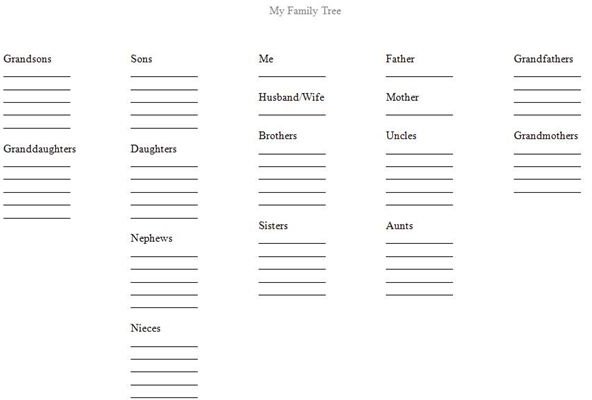
After the English language students are comfortable with the family vocabulary, use the following activity to reinforce the lesson. Begin by having the students fill out their family trees with as many family members as possible. (A sample family tree is available for download.) Then have the ESL students practice their writing skills by writing sentences about their family tree; for example: “Mary Kay is my mother. Nordine is Mary Kay’s mother.” Writing these types of sentences also gives English language learners practice with possessive determiners and possessive nouns. After the writing section of this activity, have the students practice their English speaking skills by asking each other questions about their families and family trees; for example: “Who is Rachel? Rachel is my mother-in-law. OR My mother-in-law.”
By the end of this ESL lesson plan, English language learners should be able to talk about their families and the relationships between family members . Learning how English speakers organize the family is especially important for ESL students whose native cultures have organization systems that are different from that of English speakers.
References
- Image: African American Family by Wazzle under Public Domain
- Image: Familia by Tedejahuella under CC BY-SA 3.0
- Image: FamiliaOjeda by Ojedamd under CC BY-SA 3.0